
A laboratory can have the equipment, the people and the time set aside for a test, yet still be waiting for a cylinder of hydrogen.
For smaller users, that is a supply problem with consequences beyond the price of the gas. Someone has to arrange the order, receive the cylinders, check what is left and make sure the next delivery arrives before the supply runs out. When consumption is modest, these tasks can seem out of proportion to the amount of hydrogen actually used. But the experiment or piece of equipment depends on it all the same.
This is one of the reasons we started developing HydroCharge. Our project plan identifies the difficulty of obtaining hydrogen in small quantities and the logistics that come with it. We wanted to explore a practical alternative: producing hydrogen where it is needed, then compressing, storing and supplying it through the same system.
What changes when production moves on site
The immediate change is in replenishment. Instead of relying on a delivery for every new supply of gas, a user can produce hydrogen between periods of consumption. Storage provides a buffer between those two activities.
Take a research group that uses hydrogen for occasional tests. Its largest demand may come during a short testing session, while production could take place over a much longer period beforehand. Choosing an electrolyzer solely around the highest instantaneous demand would miss that opportunity. The more useful question is how much hydrogen the group needs for its work, and how long it has to rebuild the reserve. Another user may consume hydrogen throughout the day. The same arrangement may not suit them at all.
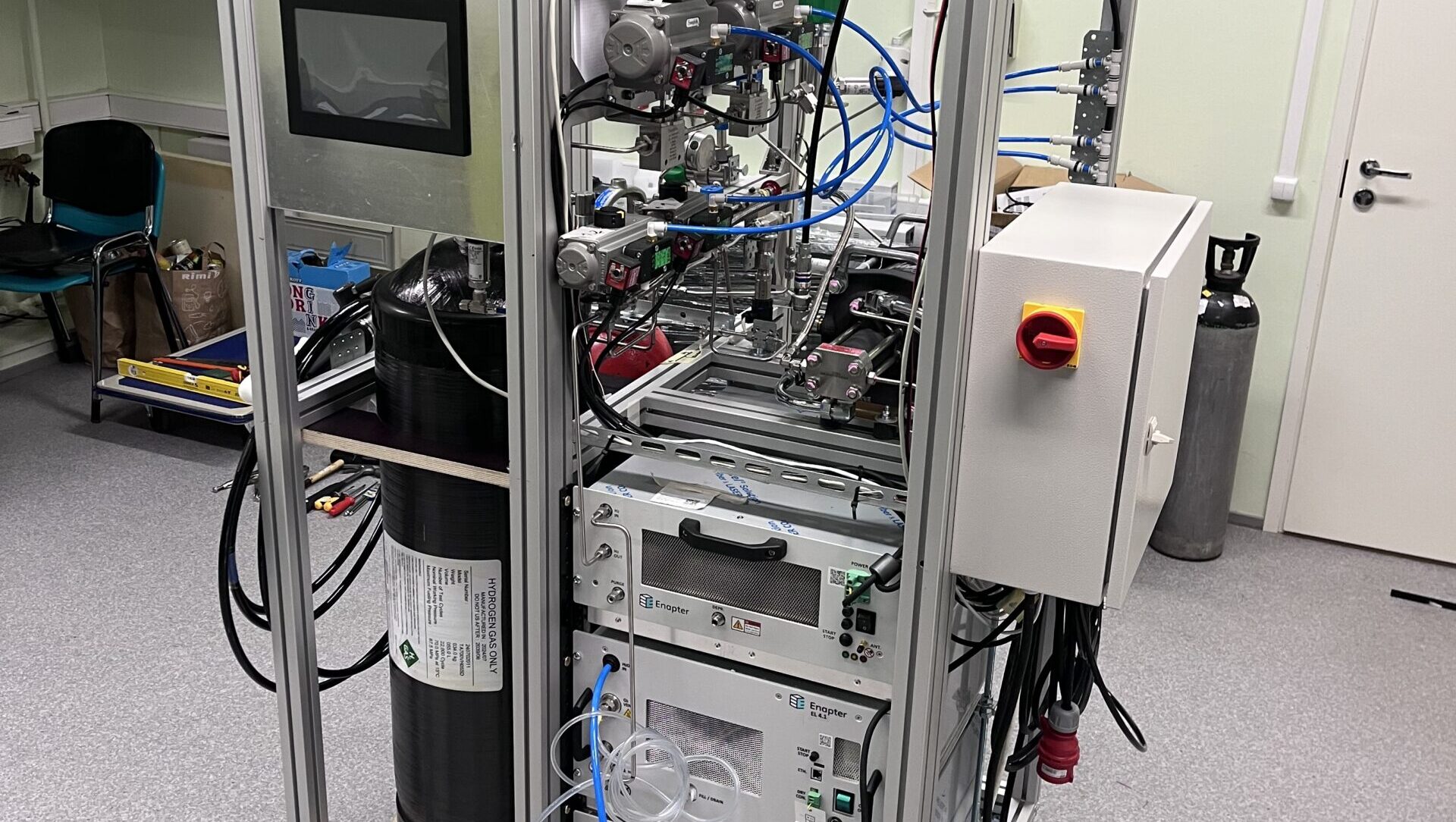
HydroCharge’s first iteration brought the essential functions together in an automatically operated prototype. It produces hydrogen, compresses it and enables refueling. Building those functions into one working system gave us a basis for the next stage of development, where the focus includes modularity, usability and reliability.
There is also a cost trade-off. Large production facilities can spread their costs across greater volumes, while local production can reduce the delivery part of the bill. The US Department of Energy describes this balance in its overview of hydrogen delivery. Smaller production is not automatically cheaper; the comparison has to include the gas as it reaches the user, together with the work required to keep that supply available.

A reserve is only useful if it covers the interruption
Local production gives the operator more influence over the supply schedule. It also brings equipment to maintain and dependencies to manage. Electricity and suitable water must be available, and a service visit still takes time. For a user whose work cannot tolerate interruptions, these details belong in the supply plan from the beginning.
We would start that discussion with the consequence of running out. Can a test be postponed? Would a stopped process lose a day’s work? How much notice does the operator have before the next period of demand? Those answers help establish whether the installation needs a larger reserve, an alternative source or a different production schedule.
The required purity, pressure and connection matter just as much. Hydrogen sitting in storage is only useful if it can be supplied in the form the application requires.
Our modular development direction allows production, compression, storage and refueling to be considered separately when shaping a configuration. That is useful because two customers with similar annual consumption may need very different systems. One may want a small unit that replenishes slowly. Another may need to recover quickly after a busy period.
HydroCharge — From Our First Prototype to the Next Iteration